One cell. Two modes.

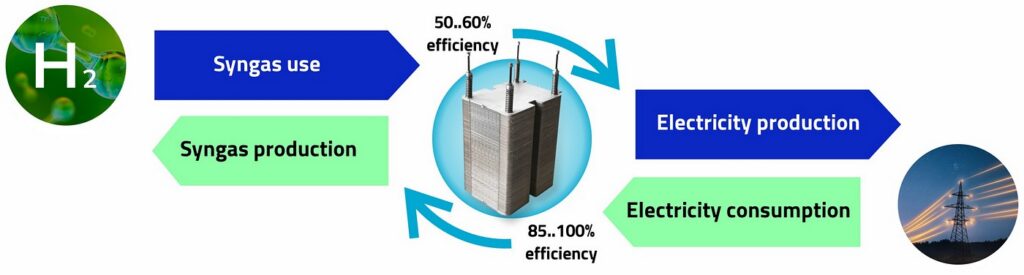
Generate clean power in fuel cell mode or produce green hydrogen in electrolysis mode.

SOFC - Fuel cell mode

Elcogen cells used in fuel cell mode have demonstrated excellent resistance to thermal cycling and are highly versatile due to their fuel flexibility.

Solid oxide fuel cells generate electricity and heat as a by-product through an electrochemical process using hydrogen or hydrogen-containing fuels. Electrode-supported solid oxide cells feature an anode made from a ceramic-metal composite. The electrodes are separated by a thin ceramic electrolyte with a protective ceramic layer between the air electrode and the electrolyte. An optional air electrode contact layer improves electrical contact and reduces overall resistance.

Thermal
cycling
Fuel
flexibility
Proprietary
technology
Low operating
temperature
Customisable
structure

Elcogen cells have been tested in-house, in research institutions, and in practical applications. They have shown higher electrochemical performance than other commercially available solid oxide cells, achieving over 75% efficiency at the stack level using natural gas (lower heating value) while operating at wide temperature range, starting from 600°C (compared with the industry average of 750–900°C).

33 kWh/kg
for Hydrogen production
75%
Fuel cell electrical efficiency
600-750°C
Operating temperature

SOEC - Electrolysis mode

Elcogen cells in electrolyser mode have demonstrated excellent resistance to degradation. With the optional air side contact layer and improved electrode contact in reversible operation, the efficiency has been shown to reach 80%.

Elcogen cells represent one of the market’s most efficient solid oxide electrolysis technology (SOEC), achieving specific energy consumption for hydrogen production below 3 kWh/Nm³ while operating efficiently at 600–750°C, compared with the industry average of 750–900°C. The cells are suitable for electrolysis, co-electrolysis (co-SOEC), and reversible operation (rSOC).

Air electrode contact
Cell design support
Power-2-X
Low operating temperature

The electrolysis function of solid oxide cells is not limited to hydrogen production but is also crucial for Power-to-X applications, syngas production and more. By working closely with our customers, we help them customise and integrate our cells into their stacks to meet their specific requirements.

Empowering the energy ecosystem with technology that delivers

Improved system economics: The comparatively low operating temperature supports longer service life while enabling the use of lower-cost materials at stack and system level. The result is improved overall system economics.
With you all the way: We offer integration support covering consultancy on process and system design, advice on balance-of-plant component and material selection, simulations and process calculations with consultation on testing and operation procedures.
Designed to meet your needs: We offer two standard product families (300-C and 400-B). Custom sizes and geometries can also be developed to meet specific customer requirements.
Mass-manufacturing capabilities: Our brand new state-of-the-art 14,000 m² production facility has increased production capacity to 360 MW, positioning the company as one of Europe’s largest manufacturers of high-efficiency SOFC and SOEC technology.

rSOC - Reversible SOC

Our reversible SOC technology allows for the same system to run in both fuel cell and electrolysis mode. 

This reversibility is seen as a strong disruptive innovation, that can enable a dramatic CAPEX reduction in a power-to-power chain, as only one asset is needed, instead of the two required in a standard power-to-X-to-power chain.

Fuel cell technical data

Technical data ASC-300C ASC-400B
Fuel contact layer NiO NiO
Fuel electrode support composition NiO/YSZ NiO/YSZ
Fuel electrode functional composition NiO/YSZ NiO/YSZ
Electrolyte composition YSZ YSZ
Electrolyte thickness 3 or 6 μm 3 or 6 μm
Half-cell thickness 300 μm 400 μm
Half-cell tolerance ±30 μm ±40 μm
Barrier composition GDC GDC
Oxygen electrode composition LSC LSC
Thickness of oxygen electrode 15 μm 15 μm
Total thickness 315 μm 415 μm
Thickness tolerance ±35 μm ±45 μm
Suggested operating temp 600–750 °C 600–750 °C
Standard size (cell) 12x12 cm 12x12 cm
Standard size of active area 11x11 cm 11x11 cm
Different sizes available + +
Different shapes available + +
Half-cells available + +
Contact layer of Oxygen electrode available + +
Technical data
Fuel contact layer
ASC-300C
NiO
ASC-400B
NiO
Technical data
Fuel electrode support composition
ASC-300C
NiO/YSZ
ASC-400B
NiO/YSZ
Technical data
Fuel electrode functional composition
ASC-300C
NiO/YSZ
ASC-400B
NiO/YSZ
Technical data
Electrolyte composition
ASC-300C
YSZ
ASC-400B
YSZ
Technical data
Electrolyte thickness
ASC-300C
3 or 6 μm
ASC-400B
3 or 6 μm
Technical data
Half-cell thickness
ASC-300C
300 μm
ASC-400B
400 μm
Technical data
Half-cell tolerance
ASC-300C
±30 μm
ASC-400B
±40 μm
Technical data
Barrier composition
ASC-300C
GDC
ASC-400B
GDC
Technical data
Oxygen electrode composition
ASC-300C
LSC
ASC-400B
LSC
Technical data
Thickness of oxygen electrode
ASC-300C
15 μm
ASC-400B
15 μm
Technical data
Total thickness
ASC-300C
315 μm
ASC-400B
415 μm
Technical data
Thickness tolerance
ASC-300C
±35 μm
ASC-400B
±45 μm
Technical data
Suggested operating temp
ASC-300C
600–750 °C
ASC-400B
600–750 °C
Technical data
Standard size (cell)
ASC-300C
12x12 cm
ASC-400B
12x12 cm
Technical data
Standard size of active area
ASC-300C
11x11 cm
ASC-400B
11x11 cm
Technical data
Different sizes available
ASC-300C
+
ASC-400B
+
Technical data
Different shapes available
ASC-300C
+
ASC-400B
+
Technical data
Half-cells available
ASC-300C
+
ASC-400B
+
Technical data
Contact layer of Oxygen electrode available
ASC-300C
+
ASC-400B
+

Interested in our products? Contact our team with any questions:

"*" indicates required fields

Looking to integrate next-generation solid oxide technology? Let’s make it work for you!

Hannu Anttila

Sales Director

sales@elcogen.com
Hannu Anttila